What is an Aircraft Tire “Casing”?
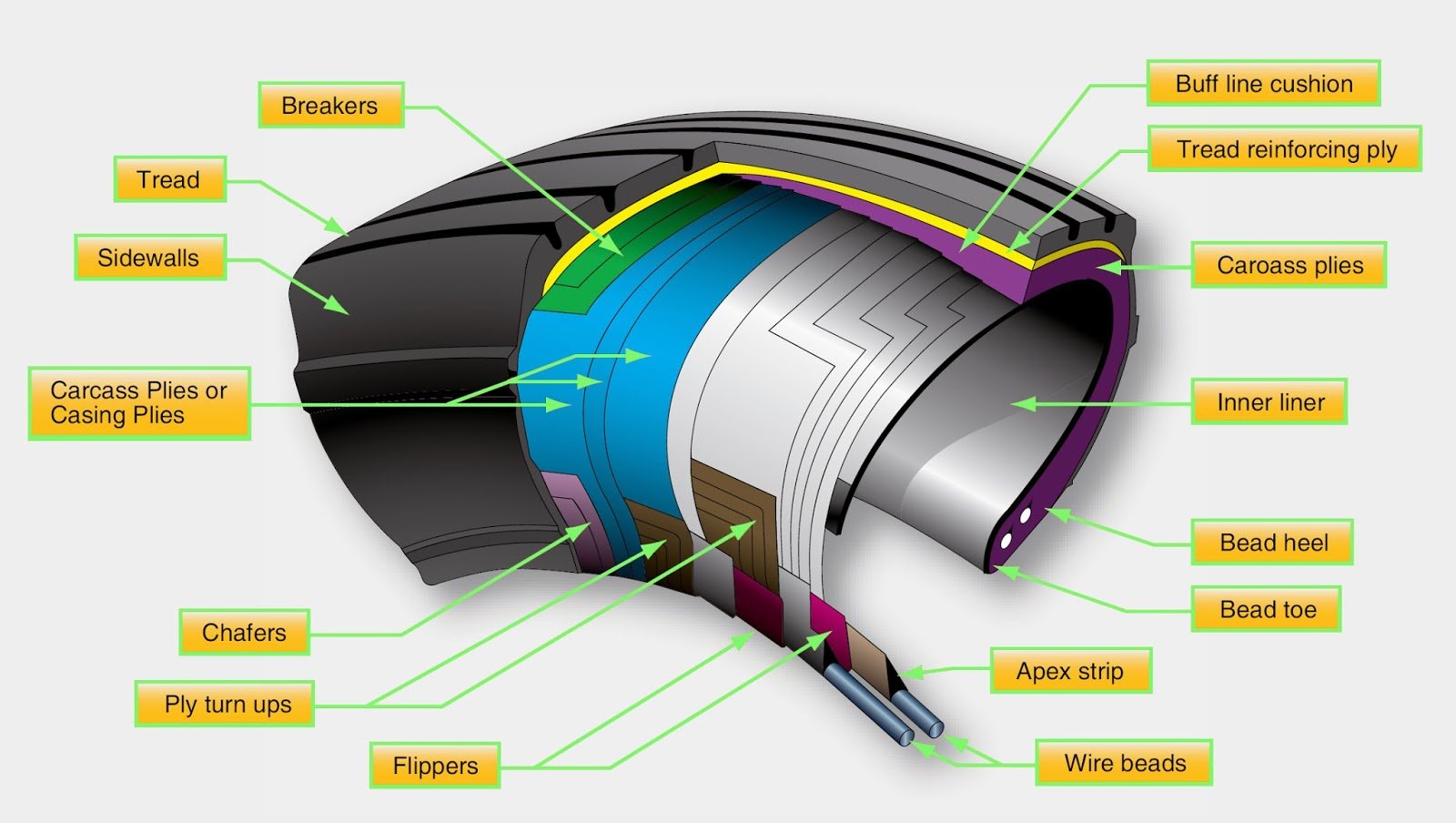
- The casing is the structural body of the tire — all the layers of fabric, cords, plies, beads, and inner liner that form the tire’s skeleton.
- The tread rubber is applied over the casing, but it’s the casing that actually carries the aircraft’s weight and resists the massive forces of takeoff/landing.
- In fact, in aviation tire maintenance, a casing that passes inspection can be retreaded many times, while the tread rubber is replaced.
Think of it as the chassis of the tire — the reusable backbone.
What is the Casing Made Of?
- Cord plies: Nylon, polyester, aramid (Kevlar®), or hybrid composites laid at angles to provide strength.
- Carcass plies: Layers of cords embedded in rubber that give the tire its main load-carrying capacity.
- Belts / breakers (in radials): Additional circumferential layers that stabilize the tread and casing.
- Beads: Bundles of steel wire that anchor the casing to the wheel rim.
- Inner liner: Airtight rubber compound that seals in nitrogen or air.
How is Casing Strength “Calculated” or Rated?
The casing’s capacity is not expressed as a single number, but evaluated through design + certification tests:
- Ply Rating / Load Rating
- The casing’s plies determine how much weight the tire can carry.
- Example: A 26-ply rating casing can withstand far higher loads than a 12-ply rating casing, even if both are the same size.
- The casing’s plies determine how much weight the tire can carry.
- Bead Strength
- The casing must lock to the rim without slipping or distorting under high torque and braking loads.
- The casing must lock to the rim without slipping or distorting under high torque and braking loads.
- Burst Strength Tests
- The casing is pressurized until failure to verify a large safety margin (often 4x rated pressure).
- The casing is pressurized until failure to verify a large safety margin (often 4x rated pressure).
- Retreadability
- The casing is evaluated for how many times it can be safely retreaded — some Michelin/Goodyear casings last 5–7 retreads before retirement.
- The casing is evaluated for how many times it can be safely retreaded — some Michelin/Goodyear casings last 5–7 retreads before retirement.
How Does the Casing “Work”?
- Load Distribution:
The cord plies in the casing spread the aircraft’s weight across the footprint so no one spot takes all the stress. - Shape Control:
The casing resists deformation (ballooning) under high pressure (~200 psi) and high centrifugal force at landing speeds (200+ mph). - Heat Management:
The casing structure allows heat to dissipate from tread and sidewalls, preventing reversion and delamination. - Flex & Shock Absorption:
The casing flexes just enough to absorb impact on landing, but not so much that it overheats or distorts.
Why the Casing is Critical
- The casing is the most expensive part of the tire. The tread is consumable, but the casing is designed to last for years.
- If the casing is damaged (cuts, exposed cords, ply separations, sidewall bulges), the tire must be scrapped — no retread allowed.
- Operators track casings by serial number to maximize lifecycle cost: retread after retread until casing fatigue retires it.
Summary
- Casing = structural body of the tire.
- Built of plies, beads, liner, and reinforcement layers.
- Its strength is tested by ply rating, burst tests, and retreadability.
- It works by distributing load, resisting distortion, and handling heat.
- Retreading makes the casing the most valuable part of an aircraft tire.